Fascin (Fascin 1)
(Actin Binding Protein)
Cat. #: 8411-01
.....................................................................................................................................................................................................................................................................................................................................................................................................................................................
Description
|
|
|
|
Protein
|
Fascin (Synonyms: Fascin 1, 55 kDa actin-bundling protein, Singed-like protein, p55)
|
|
Origin
|
human recombinant - untagged.
|
|
Molecular mass
|
55kDa
|
|
Protein description
|
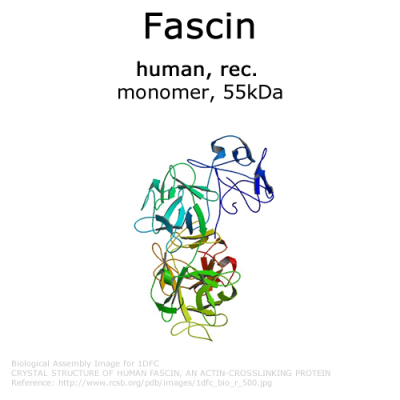
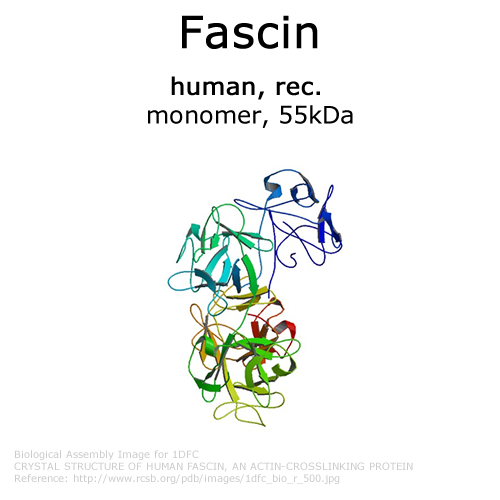
Fascin is a monomeric actin bundling protein with a molecular mass of 55kDa. The bundling of actin filaments by fascin forms filopodial bundles, that push the membrane forwards during cell movement and migration, resp. during cytoskeleton remodelling. Fascin was shown to be involved in the assembly of microspikes, stress fibers and membrane ruffles.
While fascin seems to be absent only from epithelial cells, it is upregulated in multiple forms of human carcinoma.
|
|
Actin interaction
|
Ca++-insensitive actin bundling protein.
|
Properties
|
|
|
|
Form
|
Lyophilized, ready-to-use.
|
|
Quantity per unit
|
2x 50 µg
|
|
Buffer
|
150mM NaCl, 20mM Hepes pH 7.4, 1mM DTT and 5% sucrose, when reconstituted with 50 µl ultrapure water to obtain a 1.0 mg/ml solution.
|
|
Purity & Activity
|
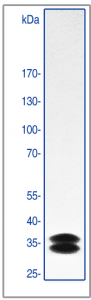
Purity: >99% by scanning densitometry from Coomassie G-250 stained SDS-Gels.
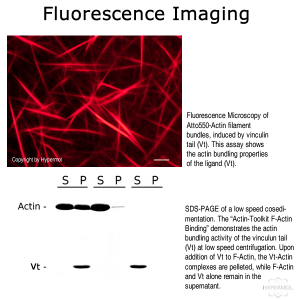
Bundling activity: 2µM Atto565-Actin (Cat.#:8162-01) was incubated with Fascin at a molar ratio of 1:10 and 1:4.1 to verify bundling by fluorecence microscopy. All proteins were used as supplied, i.e. without dialysis. The actin stock solution was pre-spun 15min, 15.000xg, 4°C.
Low speed cosedimentation assay was performed (20,000xg, 30min) with rabbit skeletal muscle actin (Cat.#:8101-03) in the presence of sugars. At a molar ratio of 4. : 1 (actin : fascin), fascin was mixed with F-actin. After 30min at RT, the samples were used for low speed spinning. SDS-PAGE showed, that fascin was completely pelleted with F-actin.
|
|
Purification notes
|
Fascin protein was amplified from human macrophage cDNA and expressed as a GST-tag fusion protein in E. coli. After purification by GST-Agarose and subsequent GST-tag cleavage, the pure protein was yielded by gel filtration chromatography.
|
|
Protein concentration
|
Determined by OD280 (0.1%=1.224).
|
|
Storage instructions
|
Fascin is stored at –70°C upon arrival will be stable in performance for at least 6 months from the date of purchase. The solubilized protein is kept on ice and should be stored at -20°C in glycerol or CryoProtect (Cat.#: 6011-01). Avoid repeated freeze / thaw cycles.
|
|
Shipping conditions
|
At ambient temperature. Upon delivery store at -70°C.
|
|
Remarks
|
|
|
CAS no.
|
|
Further Information
 Product DataSheet
 Protein Sequence on NCBI
 Protein Sequences and Structures on RCSB
 Material and Safety Data Sheet
References
Reconstitution of contractile actomyosin rings in vesicles.
Litschel T, Kelley CF, Holz D, Adeli Koudehi M, Vogel SK, Burbaum L, Mizuno N, Vavylonis D, Schwille P.Nat Commun. 2021 Apr 15;12(1):2254. doi: 10.1038/s41467-021-22422-7.
Structure, evolutionary conservation, and conformational dynamics of homo sapiens fascin-1, an f-actin crosslinking protein.
Sedeh RS, Fedorov AA, Fedorov EV, Ono S, Matsumura F, Almo SC, Bathe M
J.Mol.Biol. (2010) 400 p.589