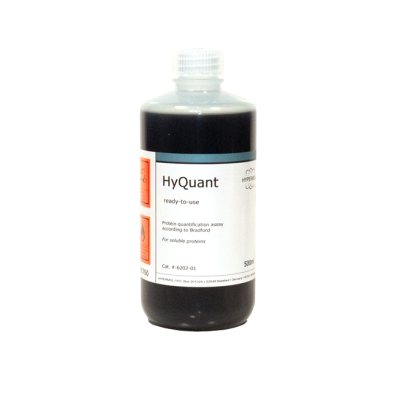
HyQuant (Bradford Assay)
Easy-to-use & fast one step solution
Cat.#: 6410-01
..........................................................................................................................................................................................................................................................................................................................................................................................................
Description
The HyQuant reagent is a one-step Bradford Assay for fast and easy handling. The Assay Reagent is a ready-to-use solution for measuring protein concentrations. Add the Bradford reagent to the sample - equal volumes of samples and standards -, mix well and measure the absorbance at 595nm. The colorimetric assay can be performed either in cuvettes with a spectrophotometer or in microtiter plates using a plate reader.
500ml
Concentrations of substances compatible with the HyQuant Assay.
|
| Substance |
Compatible Conc. |
| Ammonium Sulfate |
1.0M |
| EDTA |
0.1M |
| Glycine |
0.1M |
| Glucose |
1.0M |
| Glycerol |
5% |
| CHAPS |
0.03% |
| SDS |
0.005% |
| Sodium Azide |
0.5% |
| Tris |
2.0M |
| Triton X-100 |
0.025% |
Due to the high dilution of the sample and the reagents contained within, the use in cuvettes is essentially compatible with many chemicals.
Literature
1. Bradford (1976), Anal. Biochem. 72, 248-254.
2. Chial und Splittgerber (1993), Anal. Biochem.213, 362-369.
3. Compton und Jones (1985), Anal. Biochem.151, 369-374.
4. Pande und Murthy (1994), Anal. Biochem. 220, 424-426.
This product is currently only available in Europe.