Product Datasheet
Rabbit Anti-Mouse IgG (H+L) ATTO490LS
Antibody produced in Rabbit, affinity purified
Cat. # 2404-1MG
............................................................................................................................................................................................................................................................................................................................................................................................................
Description
|
Product name |
Rabbit Anti-Mouse IgG ATTO490LS |
|
Target species |
Mouse |
|
Description |
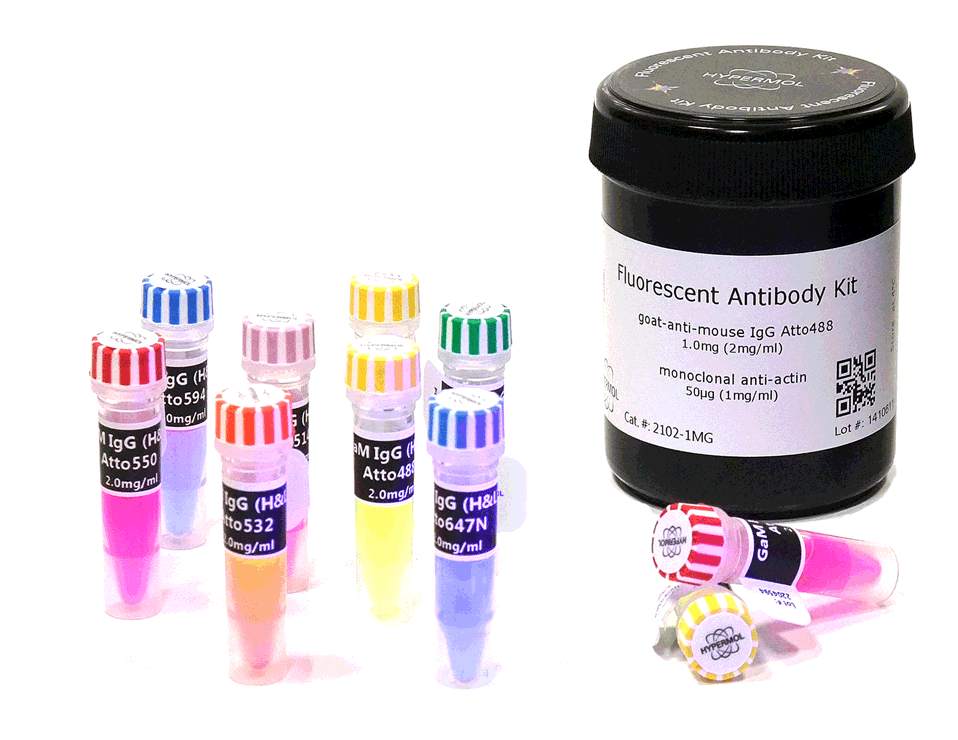
ATTO-labeled secondary antibodies belong to the new generation of fluorescent antibodies, characterized by their exceptional fluorescence intensity and superior photostability.
Rabbit Anti-Mouse IgG ATTO490LS (H+L) is an antigen-specific antibody. Affinity purification removed essentially all Rabbit serum proteins, including immunoglobulins not specifically binding to Mouse IgG. Rabbit Anti-Mouse IgG is conjugated to ATTO490LS (Abs. max. 496 nm; Em. max. 661 nm) and further purified by gel filtration. |
|
Specification |
Rabbit Anti-Mouse IgG ATTO490LS (H+L), Immunofluorescence: 1:500-1:1500, Degree of labeling (DOL) : 2-9, Unconjugated dye ≤5% of total fluorescence. |
|
Optical Properties |
λex 496nm, λem 661nm |
Properties
|
Form |
Lyophilized |
|
Nominal concentration |
2 mg/ml (after reconstitution with buffer) |
|
Content |
1.0 mg Rabbit Anti-Mouse IgG (H+L) ATTO490LS |
|
Clonality |
Polyclonal |
|
Isotype |
IgG |
|
Purification notes |
Column affinity purified. |
|
Storage instructions |
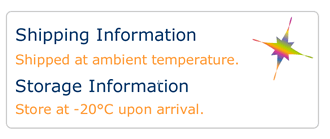
Store as glycerol stock at -20°C. Avoid repeated freeze / thaw cycles. |
|
Shipping conditions |
Shipped at ambient temperature. |
|
Remarks |
For Use in Research only. Not for Use in Human or Veterinary Diagnostical or Therapeutical Applications. |
|
CAS no. |
Further Information
 Product DataSheet
  Material and Safety Data Sheet
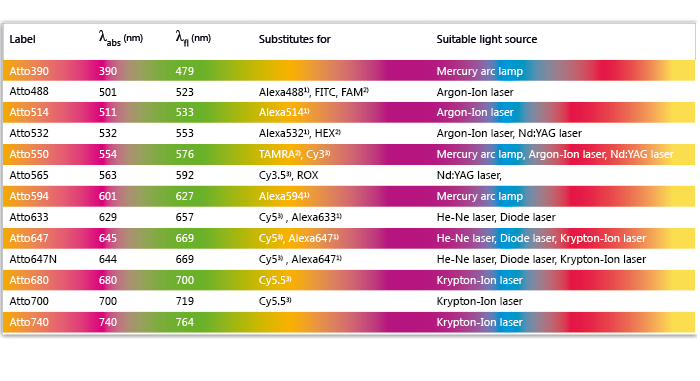 Table of Dyes and Light Sources
 Catalogue: ATTO Secondary Antibodies
References
Super-multiplex vibrational imaging.
Wei L, Chen Z, Shi L, Long R, Anzalone AV, Zhang L, Hu F, Yuste R, Cornish VW, Min W.
Nature. 2017 Apr 27;544(7651):465-470. doi: 10.1038/nature22051. Epub 2017 Apr 19.
αv Integrins combine with LC3 and atg5 to regulate Toll-like receptor signalling in B cells.
Acharya M, Sokolovska A, Tam JM, Conway KL, Stefani C, Raso F, Mukhopadhyay S, Feliu M, Paul E, Savill J, Hynes RO, Xavier RJ, Vyas JM, Stuart LM, Lacy-Hulbert A.
Nat Commun. 2016 Mar 11;7:10917. doi: 10.1038/ncomms10917.
Mechanical signaling coordinates the embryonic heartbeat.
Chiou KK, Rocks JW, Chen CY, Cho S, Merkus KE, Rajaratnam A, Robison P, Tewari M, Vogel K, Majkut SF, Prosser BL, Discher DE, Liu AJ.
Proc Natl Acad Sci U S A. 2016 Aug 9;113(32):8939-44. doi: 10.1073/pnas.1520428113. Epub 2016 Jul 25.
Product DataSheet
Material and Safety Data SheetTable of Dyes and Light Sources Catalogue: ATTO Secondary Antibodies
Bitbow Enables Highly Efficient Neuronal Lineage Tracing and Morphology Reconstruction in Single Drosophila Brains.
Li Y, Walker LA, Zhao Y, Edwards EM, Michki NS, Cheng HPJ, Ghazzi M, Chen TY, Chen M, Roossien DH, Cai D.
Front Neural Circuits. 2021 Oct 20;15:732183.
Super-multiplex vibrational imaging.
Wei L, Chen Z, Shi L, Long R, Anzalone AV, Zhang L, Hu F, Yuste R, Cornish VW, Min W.
Nature. 2017 Apr 27;544(7651):465-470. doi: 10.1038/nature22051. Epub 2017 Apr 19.
αv Integrins combine with LC3 and atg5 to regulate Toll-like receptor signalling in B cells.
Acharya M, Sokolovska A, Tam JM, Conway KL, Stefani C, Raso F, Mukhopadhyay S, Feliu M, Paul E, Savill J, Hynes RO, Xavier RJ, Vyas JM, Stuart LM, Lacy-Hulbert A.
Nat Commun. 2016 Mar 11;7:10917. doi: 10.1038/ncomms10917.
Mechanical signaling coordinates the embryonic heartbeat.
Chiou KK, Rocks JW, Chen CY, Cho S, Merkus KE, Rajaratnam A, Robison P, Tewari M, Vogel K, Majkut SF, Prosser BL, Discher DE, Liu AJ.
Proc Natl Acad Sci U S A. 2016 Aug 9;113(32):8939-44. doi: 10.1073/pnas.1520428113. Epub 2016 Jul 25.