


Latrunculin A

...........................................................................................................................................................................................................................................................................................................................................
Applications
Cell-permeant natural compound for prevention of actin polymerization, frequently used in in vitro assays
Description
|
Product name |
Latrunculin A (from sea sponge) |
|
Product description |
Latrunculin A is a bioactive macrolide derived from sponges that efficiently sequesters G-actin and prevents F-actin assembly. Latrunculin A binds monomeric actin in a 1:1 molar stoichiometry and is frequently used to block actin polymerization in vitro (Kd = 0.2 μM)1. |
|
Overview |
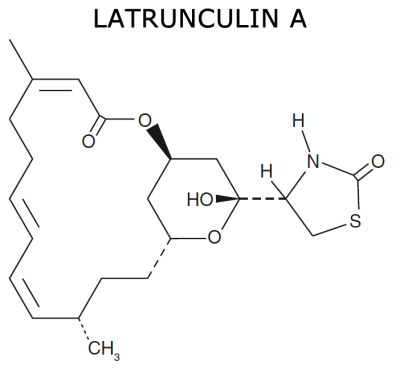
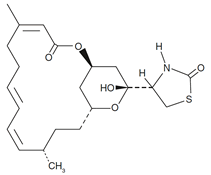
Latrunculin A is a cell-permeant macrolide with a 2-thiazolidinone ring. Latrunculin A disrupts actin polymerization due to formation of a 1:1 complex with monomeric G-actin, without affecting the microtubules. Latrunculin A inhibits binding of thymosin β. |
Properties
|
Form |
Lyophilized, ready-to-use. |
|
Quantity |
50µg, add 100 µl of DMSO to obtain a 1mM stock solution. |
|
Formula |
Formal name: (4R)-[(1R,4Z,8E,10Z,12S,15R,17R)-17- hydroxy-5,12-dimethyl-3-oxo-2,16-dioxabicyclo[13.3.1]nonadeca- 4,8,10-trien-17-yl]-2-thiazolidinone;
Molecular weight; 421.6 g/mol |
|
Purity |
98% HPLC; |
|
Storage instructions |
Store at –20°C upon arrival. The product will be stable in performance for at least 1 year from the date of purchase. |
|
Shipping conditions |
At ambient temperature. Upon delivery store at -20°C. |
|
Remarks |
For Use in Research only. Not for Use in Human or Veterinary Diagnostical or Therapeutical Applications. |
|
CAS no. |
|
References
Yarmola EG, Somasundaram T, Boring TA, Spector I, Bubb MR.
J Biol Chem. 2000 Sep 8;275(36):28120-7.