Myosin II
Cat. #: 8326-01
(Actin Binding Protein)
..................................................................................................................................................................................................................................................................................................................................................................................
Description
|
Protein |
Myosin II |
|
Origin |
Skeletal muscle, rabbit (m.psoas) |
|
Molecular mass |
~480kDa |
|
Protein description |
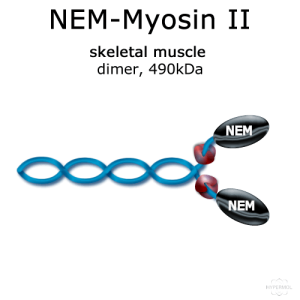
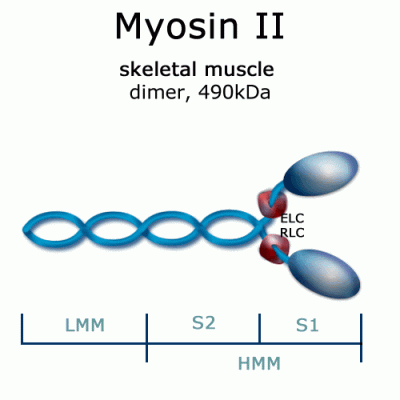
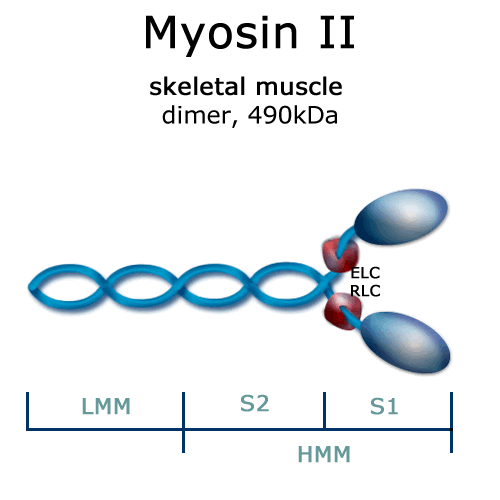
Fast muscle myosin II from rabbit psoas muscle is a hexameric, actin-binding ATPase with a total molecular weight of 480kD in a head- and-tail conformation. Myosin II has two identical head domains, where the actin binding sites are localized. It consists of two heavy chains (each 220kD) and four light chains (ELC=essential and RLC= regulatory light chains). |
|
Actin interaction |
Binds to F-actin. |
Properties
|
Form |
Lyophilized, ready-to-use. |
|
Quantity per unit |
2x100 µg |
|
Buffer |
500mM KCl, 50mM Hepes pH 7.0, 1mM TCEP, 5mM, 0.5mM EDTA and 10% sucrose when reconstituted with 0.1ml ultrapure water to obtain a 1mg/ml solution. |
|
Purity |
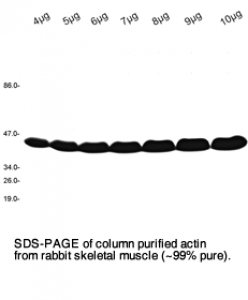
>98% by scanning densitometry from Coomassie G-250 stained SDS-Gels. |
|
Purification notes |
Purified from rabbit skeletal muscle (m. psoas). |
|
Protein concentration |
Determined by Biuret method with actin (rabbit skeletal muscle) as reference. |
|
Storage instructions |
Upon reconstitution the product is stored on ice. This product can also be stored as a glycerol stock at -20°C. Avoid repeated freeze / thaw cycles. |
|
Shipping conditions |
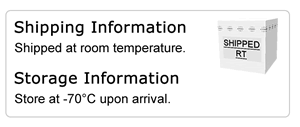
At ambient temperature. Upon delivery store at -70°C. |
|
Remarks |
For coated or filamentous myosin II MotorMix I (Cat. #: 5502-01) or PolyMix (Cat. #: 5000-0*) can be used.MotorMix II (Cat. #: 5503-01) is required for soluble myosin II. |
|
CAS no. |
Further Information
 Product DataSheet
 Material and Safety Data Sheet
References
Reconstitution of contractile actomyosin rings in vesicles.
Litschel T, Kelley CF, Holz D, Adeli Koudehi M, Vogel SK, Burbaum L, Mizuno N, Vavylonis D, Schwille P.Nat Commun. 2021 Apr 15;12(1):2254. doi: 10.1038/s41467-021-22422-7.
Product DataSheetMaterial and Safety Data Sheet
Reconstitution of contractile actomyosin rings in vesicles.
Litschel T, Kelley CF, Holz D, Adeli Koudehi M, Vogel SK, Burbaum L, Mizuno N, Vavylonis D, Schwille P.Nat Commun. 2021 Apr 15;12(1):2254. doi: 10.1038/s41467-021-22422-7.